
BLOG
BLOG
How to Read Gearbox Specification Sheets (Torque, Ratio, RPM)
Reading a gearbox specification sheet becomes simple once you understand what each term means and how they interact. A gearbox (speed reducer / gear reducer) converts a motor’s speed (RPM) into the required output speed while multiplying torque. This trade-off is defined by the gear ratio and adjusted by efficiency, rated torque, and peak torque.
This guide explains the core terms, key formulas, step-by-step calculations, and a selection checklist so you can confidently interpret any gearbox data sheet.
Key Terms & Core Formulas (Cheat Sheet)
Gear Ratio (i)
Usually written as 100:1, 50:1, or 5:1.
Formula:
i = Input Speed ÷ Output Speed
Higher ratio → slower output speed, higher torque
Lower ratio → faster output speed, lower torque
RPM (Revolutions Per Minute)
Represents shaft speed. Gearbox sheets will list both input RPM (from motor) and expected output RPM.
Torque (T)
Rotational force. Units: N·m or lb-ft.
Power–Torque–Speed Conversion Formula
This converts motor power and speed into torque:
T (Nm)=9550×P (kW)n (RPM)T\;(\text{Nm}) = \frac{9550 \times P\;(\text{kW})}{n\;(\text{RPM})}T(Nm)=n(RPM)9550×P(kW)
Output Torque (approximate)
Tout=Tin×i×ηT_{out} = T_{in} \times i \times \etaTout=Tin×i×η
Where η is gearbox efficiency (0.90 = 90%).
Efficiency (η)
Represents losses in gears, bearings, and seals.
Spur / bevel gearboxes: typically high efficiency
Worm gearboxes: lower efficiency
Service Factor
A multiplier ensuring the gearbox can handle real-world load variations such as stopping/starting, shock loads, or reversing.
A higher service factor is needed for heavy-duty or irregular loads.
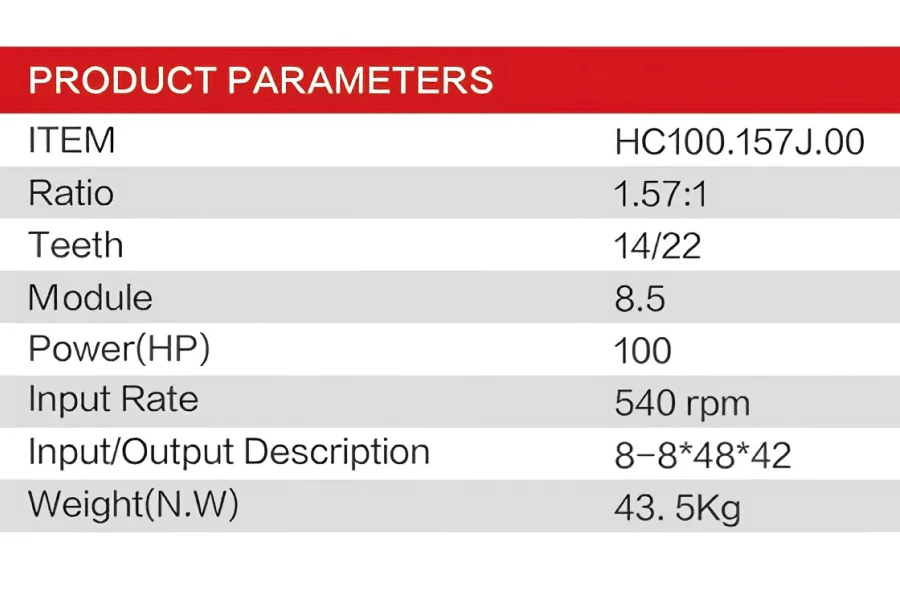
How to Read the Specification Sheet — Step by Step
1. Find the Motor Specs
Start with the motor’s rated power (kW or HP) and rated RPM. This defines the input conditions for the gearbox.
2. Check the Gearbox Ratio (i)
This is usually clearly labeled.
If multiple stages are listed, multiply them to get the overall ratio.
3. Calculate the Output Speed
Output RPM=Motor RPMGear Ratio\text{Output RPM} = \frac{\text{Motor RPM}}{\text{Gear Ratio}}Output RPM=Gear RatioMotor RPM
4. Determine Input Torque
If the motor sheet does not show torque directly, calculate it using the power torque formula above.
5. Estimate Output Torque
Tout≈Tin×i×ηT_{out} \approx T_{in} \times i \times \etaTout≈Tin×i×η
This gives a realistic torque value after losses.
6. Check Rated & Peak Torque
Spec sheets list at least two values:
- Rated (continuous) torque — safe for long-term use
- Peak (short-term) torque — for brief loads such as starting or shocks
Your required torque should fit within these limits, considering the service factor.
7. Review Service Factor and Thermal Limits
A gearbox may meet torque needs but still fail if heat buildup is not managed.
Check duty cycle, allowable thermal load, and cooling conditions.
Worked Examples
Example A — High Ratio (Heavy Lifting Equipment)
Motor: 5 kW, 3000 RPM
- Input torque:
Tin=9550×53000≈15.92 N\cdotpmT_{in} = \frac{9550 \times 5}{3000} ≈ 15.92\ \text{N·m}Tin=30009550×5≈15.92 N\cdotpm - Ratio: 100:1
- Output RPM = 3000 ÷ 100 = 30 RPM Efficiency: 95%
- Output torque:
15.92×100×0.95≈1512 N\cdotpm15.92 × 100 × 0.95 ≈ 1512\ \text{N·m}15.92×100×0.95≈1512 N\cdotpm - The gearbox’s rated torque must safely exceed this requirement.
Example B — Low Ratio (Pump or Fan Application)
Motor: 5 kW, 3000 RPM, ratio 5:1
- Output speed = 3000 ÷ 5 = 600 RPM
- Output torque ≈ 15.92×5×0.95=75.6 N\cdotpm15.92 × 5 × 0.95 = 75.6\ \text{N·m}15.92×5×0.95=75.6 N\cdotpm
Low ratios keep speed high and torque modest — ideal for pumps, blowers, and conveyors.
Common Pitfalls & Quick Buyer Checklist
- Do not size the gearbox using nominal torque alone — include starting torque, shock loads, and duty cycle.
- Confirm gearbox efficiency, especially if comparing worm vs. spur vs. planetary units.
- Check thermal capacity, especially for continuous-duty industrial applications.
- If the sheet lists power instead of torque, convert using the 9550 formula to compare properly.
- Verify mounting configuration, shaft diameters, overhung load capacity, and lubrication grade.
What to Look for on a Specification Sheet
You should be able to quickly find these items:
- Gear Ratio (i)
- Rated Torque (N·m)
- Peak Torque
- Efficiency (%)
- Input RPM / Output RPM
- Service Factor
- Duty Cycle / Thermal Limits
- Shaft Dimensions
- Mounting Position
- Lubrication Requirements
Final Note — JENA’s Expertise in Gearbox Manufacturing
A clear understanding of torque, ratio, RPM, and efficiency helps you determine whether a gearbox will truly meet your operational requirements. At JENA, we design agricultural gearboxes with real-world load conditions in mind — from high-torque reducers for rotary cutters to compact, high-efficiency units for tillers and post hole diggers.
If you share your motor specs, required output speed, torque demand, and working environment, JENA’s technical team can recommend a gearbox configuration that delivers reliable performance and long service life.
REQUEST A QUOTE
OR GET MORE
INFORMATION
Leave us a message. We will contact within 12 hours.