
BLOG
BLOG
How to Choose a Gearbox for Different Potato Harvesting Conditions
Choosing a gearbox for a potato harvester comes down to matching three things: soil conditions, tractor power, and the load characteristics of the harvester. Get this decision right, and you’ll see far less downtime across the season. Get it wrong, and you’ll be tearing down and rebuilding the gearbox repeatedly when you can least afford it.
Start with the Soil
Light sandy soil offers low draft resistance, but abrasion is the real problem. Fine sand acts like sandpaper on seals, and ordinary rubber lip seals often start weeping within weeks. This application calls for dual-lip seals paired with an external labyrinth dust guard that keeps grit away from the sealing lip itself.
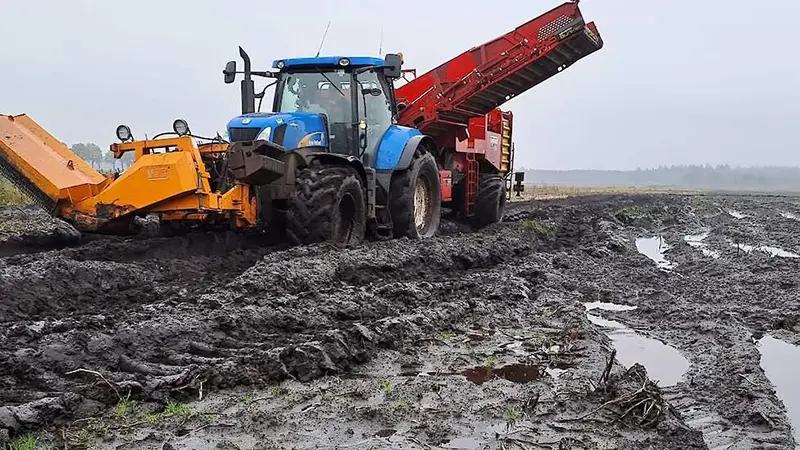
Heavy clay presents a different challenge. Wet clay creates enormous sticky resistance between the digging shares and the web chain, and the torque spikes on the gearbox input shaft go well beyond normal rated values. If you routinely work in regions with wet autumn weather, the gearbox’s torque rating should carry more margin than the manufacturer’s standard recommendation—or you should specify a cast housing designed specifically for heavy duty.
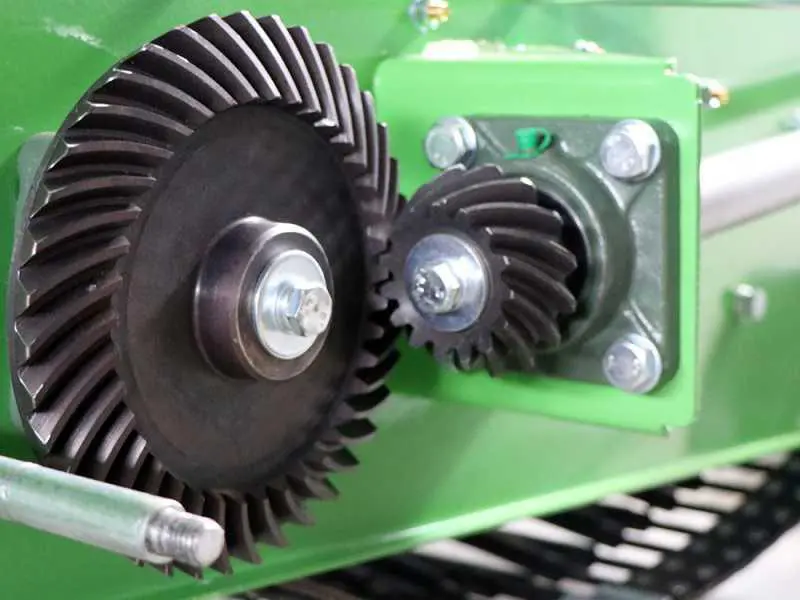
Stony ground falls somewhere in between: impact loads are frequent, and the fatigue life of gears and bearings drops noticeably. Under these conditions, gear surface hardness is the deciding factor—carburized and hardened gears at HRC 58–62 deliver several times the wear life of standard quenched-and-tempered gears.
Speed Matching Is More Subtle Than Torque
Many buyers focus only on whether the gearbox “can pull it,” overlooking the match between chain linear speed and forward speed. This is exactly the variable that drives bruising rates.
Running too slow has its own penalties—soil clods don’t separate properly, and tubers stay on the web too long, increasing the chances of impact and compression damage.
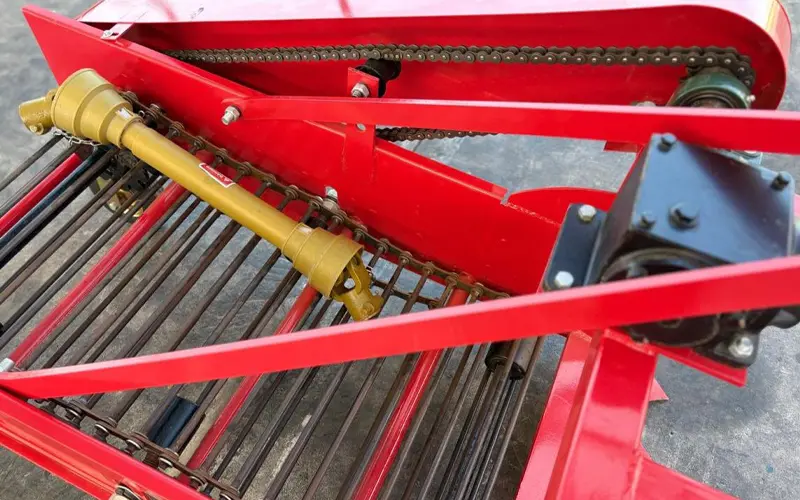
But raising speed only works if the linear speeds of each chain stage match. The primary web should run at about 1.2 times forward speed in light to medium soils; the secondary should run at roughly 0.65 times, and never below 100 ft/min, or you’ll get recirculation or tubers thrown past the next conveyor.
This means gearbox ratio selection isn’t an isolated decision—it has to be calculated together with the machine’s sprocket configuration.
If you’re running an older fixed-ratio gearbox, changing gears or sprockets is your only means of speed adjustment. Some newer gearboxes now use a superimposed planetary arrangement with hydraulic speed control, allowing in-cab stepless adjustment of web speed without stopping to swap parts when soil moisture changes. The trade-off is higher purchase cost and more complex maintenance.
Power Matching and Installation Details
Tractor PTO power must carry margin. When a gearbox runs continuously at 100% of rated torque, bearing life drops sharply. Industry practice is to specify a gearbox rated at least 20–30% above the tractor’s PTO output to handle transient peak loads in wet clay.
Installation is often overlooked but accounts for a high share of failures. Gearbox flanges must be cleaned down to bare metal before tightening. Any trapped dirt or rust becomes a fulcrum under high torque, causing hidden distortion in the cast housing and loss of bearing preload.
The output shaft-to-sprocket fit should be coated with copper-based anti-seize—field slurry works into this clearance, and without anti-seize, a sprocket will rust solid to the shaft in a single season.
Material Baselines
The housing should be at least QT 450 nodular iron. Ordinary gray iron cracks when hit. For the input shaft, 20CrMnTi carburizing steel is recommended, as the service life is directly related to the quality of the heat treatment on the splines.
Specify FKM (fluorocarbon) seals instead of standard NBR, obvious difference in temperature range and aging resistance in a hot humid harvest season.
One last practical note: the gearbox is the hardest part of the machine to fix in the field. In choosing, opt for the supplier who will provide full installation guidance and quick replacement of parts, rather than the one who offers you the cheapest unit price. The harvest window will not wait.
REQUEST A QUOTE
OR GET MORE
INFORMATION
Leave us a message. We will contact within 12 hours.