
BLOG
BLOG
Choosing a Gearbox for High Grass vs. Brush vs. Light Shrubs
A rotary cutter gearbox doesn’t know what the vegetation chart calls the field. It knows how much torque it’s being asked for, and how fast that number moves.
Grass asks in a flat line. Brush asks in spikes. A fence line full of saplings asks in hits, and on a rotary cutter those hits go through a rigid blade carrier with nothing up top to soak them, so they turn up at the gear teeth and the housing bolts.
Same 6-foot deck, two farms, two very different service lives. Rated horsepower almost never explains that gap.
So here’s the order that actually works: what’s being cut, how often, and what the deck is built to do with it. Power rating comes last, and it comes out of those three.
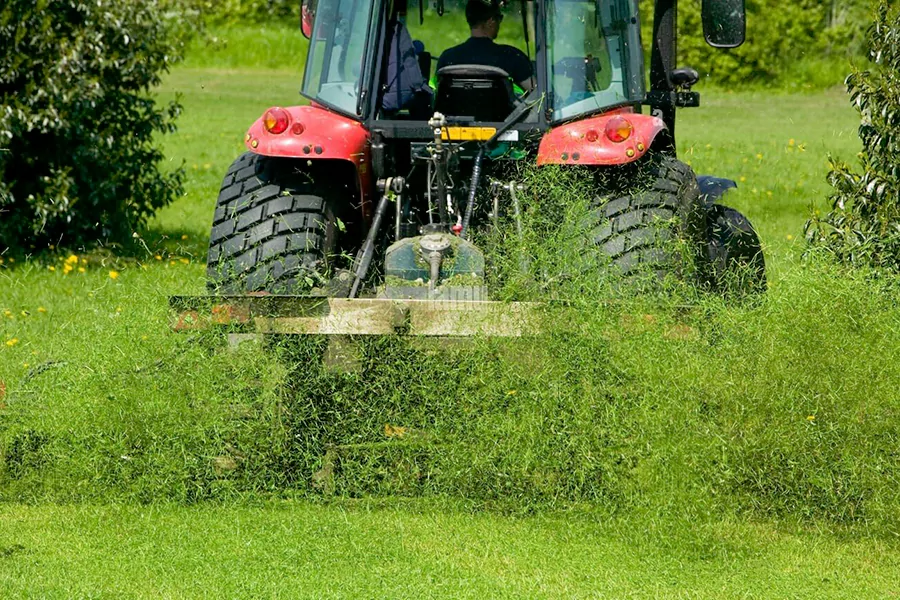
Plain grass, and why it still breaks boxes
Dry pasture is the easy job. Same material, same height, steady ground speed, and the torque demand barely wanders. A standard-duty agricultural mower gearbox handles that for years, as long as the ratio is right and the rated input power matches what’s really arriving at the input shaft.
Two things still get people.
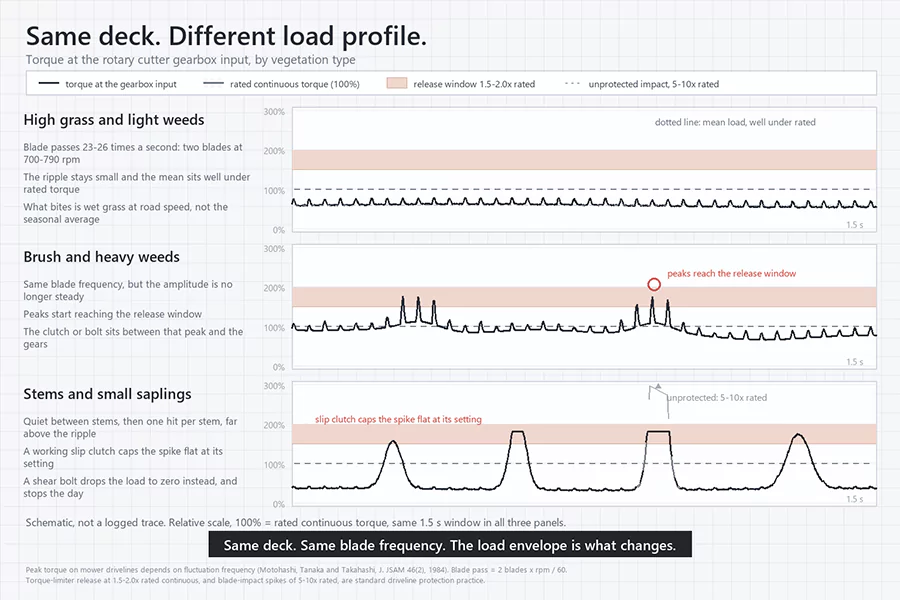
The first is wet grass at speed. Same field, same deck, and it pulls noticeably harder than the dry pass did. Nobody measures that load case, but it’s the one the box has to survive. Averages don’t break gearboxes. Peaks do.
The second is blade tip speed. Most cutters run somewhere between 13,500 and 16,500 ft/min at the tip, and it’s the gearbox ratio that turns 540 or 1,000 rpm at the PTO into that number. Take the tip speed off the deck manufacturer’s drawing and work back to a ratio. Guess it and you either get a ragged cut, or a deck dragging power it has no use for.
And no, a heavy-duty box isn’t an upgrade on a pasture topper. It’s unused margin, paid for once and carried forever.
Brush, where the numbers stop being steady
Thick stalks, woven growth, the odd stump. Resistance changes several times a second now, and the peaks are what break parts.
Allowable torque is the number to argue about, not the peak power on the label. Then gear and shaft size, then how rigid the housing is. Cast iron holds gear mesh where it belongs when the load spikes. A light housing lets it walk, and that shows up two seasons later as pitting, noise, and a box nobody wants to open.
Overload protection is the other decision, and on this class of machine it’s usually shear bolt or slip clutch. Shear bolt: cheap, predictable, stops the machine dead. Somebody climbs down, digs the stub out, and goes looking for a bolt of the right grade in the toolbox. If it’s in the toolbox, fine. Slip clutch: recovers by itself, needs its discs bedded in when new, and if the machine sits outside over a wet winter the friction plates can rust and stick together. Then it stops slipping at exactly the moment it’s supposed to slip, which is how a driveline gets twisted by the part that was fitted to protect it. Most of the ones we get asked about have never had their setting checked. Big machines run around 1,000 to 1,500 Nm.
Heat sits on this list too, and it’s underrated. Brush cut at low ground speed is one long pull, not a series of sprints. Oil capacity, housing surface area, a breather that’s actually breathing.
Stems and saplings: the shock doesn’t stop at the blade
Woody material doesn’t shear the way grass does. Blade meets stem, blade speed drops, and the driveline takes a spike far above anything that deck produced in pasture.
On a rotary cutter the blades bolt to a rigid carrier, so there’s nothing local to absorb it. It runs back through the gearbox, the PTO shaft, and into the tractor. A flail mower meets the same field differently: the flails swing on pins, and there’s usually a belt between the box and the rotor, so a sapling or a stone mostly spends itself in a swinging knife.
Which is why the maximum branch diameter comes off the cutter manufacturer’s spec sheet. Blade size, stump jumper, deck thickness, blade holder, driveline. Between them they set the cutting capacity. You can bolt the strongest gearbox in the range onto a machine that was never built to take down 4-inch stems, and the next failure won’t be the gearbox. It’ll be a blade holder or a spindle, and it’ll cost more.
Seals: worth a line. The output shaft seal sits low, in the dirt, and grit is what kills bearings long before the gears show any sign of trouble. On ground-running equipment, seal quality is a running cost, not a spec detail.
Rotary, flail, finishing: three different jobs
A rotary cutter gearbox is a right-angle bevel unit with a rigid output to the blade carrier. Two big blades, big bites, ratio stepping PTO speed up to tip speed, and shock headed straight back up the line.
Flail: rotor at 1,500 to 2,500 rpm, normally a right-angle box plus a belt stage, often an overrunning clutch so rotor inertia doesn’t push back into the tractor when the PTO drops out. Light impacts at high frequency, belt side load on the output bearing, its own heat story.
Finishing mower: lighter again. Steady load, finer cut, barely any impact duty.
Same rule for all three. Spec the box for what the deck does. The vegetation name is shorthand, and it’s rough shorthand.
Before you order, get these on paper
- PTO power at the shaft. Engine horsepower isn’t PTO horsepower, and the gearbox only ever sees what reaches its input.
- Input speed, and the spline that goes with it. 540 rpm is normally 1-3/8 inch 6-spline. 1,000 rpm is 1-3/8 inch 21-spline, or 1-3/4 inch 20-spline.
- Ratio, worked back from the tip speed or rotor speed the deck was designed around.
- Continuous versus peak. A box quoted at 150 hp continuous and 205 hp peak is giving you two numbers, and brush lives in the lower one.
- Rotation direction, mounting pattern, output shaft diameter and length, keyed or splined.
- Duty cycle. Acres a day, months a year, and whether the same machine tops pasture in June and clears fence lines in September.
- Overload protection. What it’s set to, and whether it resets in the field or needs a toolbox.
- Oil spec, capacity, level plug, breather, first change interval.
- Spares. Seal and bearing availability, and whether the unit can be rebuilt rather than replaced.
Ten seasons, or a warranty claim in year two. It usually comes down to how many of those got answered before the order went out.
JENA rotary cutter and mower gearboxes
Zhejiang JENA Transmission Technology Co., Ltd. has been building agricultural gearboxes since 2000, for equipment manufacturers and distributors. Rotary cutter gearboxes, lawn mower gearboxes, flail mower gearboxes. The rotary cutter line runs light, medium and heavy-duty, from pasture toppers up to brush cutters.
Most of the work happens before the catalogue: deck width, target tip speed or rotor speed, PTO horsepower, ground speed, what’s being cut, hours a season. Ratio, output speed, shaft and mounting follow from that.
Grass machine, spec it for grass, and spend the difference on the deck. Brush every season, and the load profile says heavy-duty, which means blades, holder, driveline and gearbox all have to agree. Send the application and we’ll spec the box to the machine you’re building.
REQUEST A QUOTE
OR GET MORE
INFORMATION
Leave us a message. We will contact within 12 hours.