
BLOG
BLOG
Agricultural Gearbox Requirements for Export: Europe vs North America
Selling an agricultural gearbox overseas isn’t just about matching a ratio and a bolt pattern. Ship the same box to Europe and to North America and you’re dealing with two different sets of paperwork, safety rules, and testing expectations.
For machinery builders and distributors, sorting out those differences early saves you a redesign, a failed certification, or a compatibility headache you didn’t see coming.
Europe runs on documentation
The European market cares a lot about safety, conformity, technical files, and traceability.
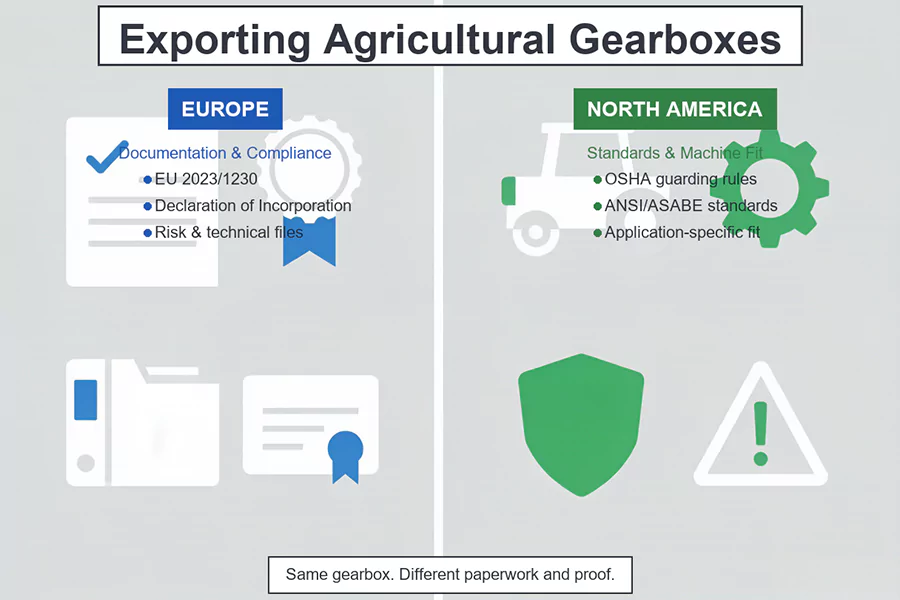
The big one is the EU Machinery Regulation (EU) 2023/1230, which replaced the old Machinery Directive. It covers machinery and related products, including removable mechanical transmission devices and partly completed machinery. Anything in scope has to meet the essential health and safety requirements and come with the right technical documentation.
What that means for a gearbox maker is that how the box is supplied matters. A gearbox going into a bigger machine isn’t the same as a standalone machine. Where it counts as partly completed machinery, the regulation calls for an EU Declaration of Incorporation and assembly instructions.
So when you’re supplying Europe, these are the things that get checked:
- Accurate specs and product identification
- Clear intended-use information
- Safety and installation documentation that’s actually there
- Traceability of the product and the production
- Risk assessment and supporting technical files where they apply
- Compatibility with the final machine and its guards
European buyers also look hard at gear machining accuracy, sealing, noise, vibration, material spec, and corrosion protection. That’s not paperwork. Those things decide how long the box lasts in the field.
North America runs on standards and real-world fit
North America is structured differently. In the US, OSHA sets the occupational safety rules for ag operations, including guarding on farm field and farmstead equipment.
On the technical side, ANSI/ASABE standards carry the weight. They’re mostly voluntary and built through industry consensus, with a lot of ISO standards adopted along the way. ANSI/ASAE S318.19 is the one for operator safety on ag field equipment, covering guarding, controls, PTO systems, manuals, and safety signs.
For a gearbox maker, the pressure is on application-specific engineering. Buyers will want to confirm:
- PTO input speed and connection
- Input and output shaft dimensions
- Ratio and output speed
- Rated horsepower and torque
- Mounting pattern
- Rotation direction
- Duty cycle and shock-load conditions
- Lubrication and sealing
- Compatibility with the machine’s guarding
A box that bolts up can still be wrong if the torque rating, PTO setup, or operating conditions don’t match the job.
What to prepare for each market
Neither market wants a “better” gearbox than the other. They want different things.
Europe leans on formal conformity, technical files, safety info, and traceability. North America leans on recognized industry standards, how the box integrates into the machine, practical safety, and how it holds up under real load.
The engineering fundamentals don’t change either way. A gearbox that lasts has the right gear materials, accurate geometry, enough bearing capacity, decent oil seals, proper lubrication, and enough strength for the torque and shock loads it’ll actually see.
That matters on rotary cutters, tillers, flail mowers, spreaders, post hole diggers, and the rest of the PTO-driven lineup. The gearbox isn’t a speed-reduction bolt-on. It’s the part of the machine that carries the power.
Picking the right agricultural gearbox supplier
For international buyers, an experienced gearbox maker simplifies the whole thing. You need more than a catalog number. Drawings, ratios, shaft specs, mounting dimensions, material data, test records, and application support all decide whether the box is right for the market and the machine.
That’s where JENA fits.
JENA Group has been making agricultural gearboxes since 2000. They supply rotary cutters, tillers, flail mowers, spreaders, post hole diggers, lawn mowers, potato harvesters, and other ag equipment. The range covers bevel gearboxes, parallel reducers, worm gear cases, and transmission housings, with OEM and ODM work for different ratios, mounts, and applications.
They work from drawings, specs, and application requirements instead of pushing a standard model. For buyers targeting Europe or North America, that’s the easier path to an agricultural gearbox that fits both the machine and where it has to run.
The question to ask before you export isn’t “does this gearbox fit?” It’s: does it fit the machine, meet the technical bar, and come with the documentation and support the target market expects?
REQUEST A QUOTE
OR GET MORE
INFORMATION
Leave us a message. We will contact within 12 hours.